New Jersey Food Journal

Monday, May 25, 2015

The Bread of Life Lessons

Photo credits: Alexandra R. Meier


By Alexandra R. Meier

Breadmaking entrepreneur John Ropelski has learned his fair share of lessons over his two and a half years of owning his part-sandwich-shop-part-bakery, &Grain.

         Score the dough before baking a baguette. This keeps the shape of the loaf straight and neat.
         No matter what detractors think, pain de mie makes great French toast. Plus, this loaf is more versatile and less expensive than brioche.
         Watch out for your reflection. It may sneak up on you late at night and spook you, as the oven’s steam makes the bakery’s glass walls look like mirrors.

Located in Garwood, &Grain offers customers eight house-made breads, from five-grain to ciabatta, that are used to accent a variety of breakfast and lunch menu options, such as harvest turkey club and French toast. The eatery’s vibrancy is palpable; saturated in natural light, the space is filled with children eating kid-friendly PB&J sandwiches and mothers sipping cold-brewed coffee.
Historically, culturally and theologically speaking, bread is life, and Ropelski stocked up on a few life lessons during his journey that helped him craft today’s customer experience. Although Ropelski acknowledges that he can talk anyone’s ear off about bread, he keeps his set of life mottos short and sweet:

1.  If it sounds too good to be true, it usually is.
           
Perhaps biological engineering obliged Ropelski to become a breadsmith; he comes from a linage of Polish bakers. But Ropelski originally intended to pursue a career in finance and clinched an opportunity to work as a mortgage broker for Smith Barney (now Morgan Stanley Wealth Management) after college. The money seemed brisk and bountiful and was, foreseeably, too good to be true. “I didn’t look at the long term plan,” Ropelski admits. He saw the writing on the wall for the market’s inevitable demise, and backed out of the mortgage industry. Unlike his colleagues, who wasted their paychecks on fancy cars, Ropelski saved his money. He had always wanted to open a business, and at that moment, the door to the metaphorical oven had opened.

Photo credits: Alexandra R. Meier


2. Nothing in life is free.

By the time &Grain opened in August 2012, Ropelski certainly understood that nothing in life is free. Hurricane Irene pushed back the first year of construction, and her big sister Sandy disrupted the eatery’s opening. By the time &Grain was up and running, Ropelski had only $3,000 to his name.

It took Ropelski a bit longer to learn that perfecting a skill also comes at a price. With his background in finance, he assumed his entrepreneurial endeavor would be a cakewalk. He would research budgeting, find equipment, and take a two-day breadmaking class. He had no desire to actually bake the bread — Ropelski just wanted to ensure that a baker couldn’t potentially use the signature recipe as blackmail. “I thought, ‘How hard could [breadmaking] be?’ ” he remembers. “I guess because [bread’s] so readily available and relatively inexpensive, it’s a food that nobody gives a second thought to.”

For Ropelski, learning bread would be a three-year process. On his first day of classes at the French Culinary, now the International Culinary Center, he told the head chef his original plan. She laughed, and warned Ropelski that he had “another thing coming to him.” So instead, Ropelski entered the school’s bread program, then exercised his practical muscles by working in New York-based bakeries. “The only way you can make good bread,” he eventually learned, “is by making a lot of bad bread.”

3. You get what you pay for.
           
This was last adage to attach itself to Ropelski’s triad of mottos. All of the mundane, methodical, and muggy hours spent baking, both as an apprentice and owner, taught him to respect craftsmanship. Before Ropelski hired a baker of his own, he spent 20 hours a day, seven days a week preparing and serving his breads. He compares this process to running a marathon. “There’s eight different breads I make here daily, and I will tell everybody that I have eight children,” he says.

Financially speaking, Ropelski usually breaks even, but he sees the most success in the response from the community. He notices his fair share of returnees. He has 4.5 stars on Yelp. And when his daughter was born, his apartment was filled to the brim with gifts from customers. “Everything I’ve ever tried to do in my life, I’ve tried to be the best at it,” he asserts. “If I was going to be a garbage man, I would be the world’s best garbage man. It’s about taking pride in what you do. I’m making bread, I want to try to make the best bread, and I can.”

Alexandra R. Meier is a Rutgers University senior, majoring in journalism and media studies. She is the former editor-in-chief of the university’s student-run newspaper, The Daily Targum, and will be interning for WABC-TV this summer.

Thursday, May 21, 2015

The Ampersand: How A Bakery in Garwood Embraced The Symbol

Photograph provided by Rachel
By Kimberly Dublin

There is so much more to &Grain, an artisan bakery in Garwood, than just delicious bread – that’s made fresh daily – and cold brewed iced Stumptown coffee on tap. It might be the quirky bicycle that sits in the middle of the café, with baguettes in its basket, as if you are walking by the transportation of choice of a French girl on the way to a picnic. It might be the handwritten chalkboard menu.

Or it could be that wherever you turn, the ampersand follows you.
The ampersand is certainly part of &Grain’s identity. The coffee cups bear the symbol. The employee aprons have ampersands embroidered on them. There are various materializations of the ampersand, all in different typography but in the same Carolignian form. (That’s this & symbol.) And John Ropelski, the owner of &Grain, certainly has thought about using the ampersand as branding, placing it on the smallest of details. Even the stickers on the to-go packages bear the little symbol.

There has been a resurgence in the usage of the ampersand. We can most likely trace it to Twitter, since the symbol saves precious space. But &Grain is not the only business to embrace the ampersand. Brands that have been around for a while, such as H&M, AT&T, Dolce & Gabbana and H&R Block, have all used the ampersand. But, for Ropelski, the ampersand has become a huge part of the identity of &Grain.

He didn’t like the name at first; it was a suggestion from his designer. “I wanted it to be Grain & Co., but she told me, ‘everyone is ‘& Co.’, everybody’s ‘& son,’” Ropelski said.

But the designer insisted, saying that it allowed people, who maybe didn’t understand the name at first, to be in the know when they got it.
Another reason Ropelski embraced the ampersand is that it puts his restaurant at the top of an alphabetical list. When New Jersey Monthly listed its “57 Hot Spots to Wake To,” his shop was first. “People thought &Grain was No. 1 because of the way it’s listed.”

But using the ampersand isn’t always easy. Ropelski has problems with vendors because sometimes ampersands are not allowed in the system they use. Social media sites, such as Facebook and Instagram, don’t allow the use of symbols in handles and URLs. Ropelski uses the word “and” to replace the ampersand.

But Ropelski isn’t all bogged down about it. A few inconveniences exist, but otherwise he is happy with the way the name turned out. Embracing the ampersand may have ultimately paid off.

Kimberly Dublin is a senior journalism student at Rutgers University. She is a contributor to TheFatKidInside.com and is an editorial intern at EdibleFeast.com

Monday, May 18, 2015

The Three Courses of Restaurant Regret

Large Meal provided by Rob Smith


By Michelle Lulic

As I sit in my tiny college dorm room, my stomach is begging me to feed it a nutritious meal. However, this healthy eating struggle is not only relevant when I am limited to eating at dining halls or heating up Ramen noodles before class. This nutrition scarcity problem occurs all school year. But the worst had to be when family members and friends wanted to take me out to dinner over Spring Break. While this may sound like a good thing, each friend, parent, and grandparent filled up my schedule with the healthy eater’s worst nightmare: “Where do you want to go out for dinner?”

Obviously, I’m not completely against going out for dinner. In fact, I love it! I have dreamt about feeling the heat of a freshly served sizzling fajita platter on my face. But allowing family to take me out for both lunch and dinner for four days straight taught me a terrible truth. Eating out is not as satisfying as you might imagine. Although my meals were varied with everything from fast-food, to chain restaurants, to mom-and-pop places, eventually it all just seemed to feel like I was eating the same thing. My food started to lose its significance as I emptied kitchens across the Long Island, New York area. I had everything from burgers, to tacos, to Chinese, to Japanese, to German, to both “Italian” at Olive Garden to Italian at my town pizzeria, Gino’s. Eventually I found myself blindly staring at each menu with no idea as to what I felt like having. I lost my appetite. My stomach needed a break.

But, why was eating out at so many restaurants making me feel so unenthusiastic about food? Only two out of the eight restaurants I ate at I didn’t thoroughly enjoy. But at the end of each day my stomach continued to feel as if it was going to explode. So, I decided to look into why I felt this way a little more. That’s where I found out the horrible truths. “As few as 3 percent” of selected Top 400 U.S chain restaurants were, “within limits for sodium, fat and saturated fat,” according to a 2013 study from Helen W. Wu and Roland Sturm. “Food portions in America's restaurants have doubled or tripled over the last 20 years,” according to The National Heart, Lung, and Blood Institute as well. In fact, “order an appetizer instead of an entrée, share an entrée or eat half of a meal and bring the rest home,” is what the National Heart, Lung, and Blood Institute suggests to people who are eating out.

Suddenly, it all made sense. Of course I was losing my appetite! Their higher portion sizes were making me take in more food than I am supposed to eat in one sitting. Plus, in addition to my initial meals, eating out made me eat more dessert than I usually do. Out of the eight restaurants, I got dessert at five of them — even when the rest of my meal was sitting half eaten in a doggy bag next to me. Dessert: a course I could have very easily avoided if I had eaten at home. 

Eating at restaurants was not only making me lose my appetite, but it also ended up emptying my bank account. Since I was “on vacation” I didn’t really pay too much attention to the prices. Therefore, I often found myself regretfully handing over my credit card to pay my share at the end of each meal. According to Zagat’s 2015 Dining Trends Survey, the average price per person for dinner out is $39.40. And that price raises to $48.15 when talking about a meal in New York City! It’s no wonder the restaurant industry plans on gaining $709.2 billion in sales in 2015.

Now that Spring Break is over, the last thing I want to do is eat out at another restaurant. I am on a search for fresh fruits and vegetables that I can prepare in my own kitchen. However, my stomach is growling as I write.

Michelle Lulic is a senior at Rutgers University, studying Journalism and Media Studies with a minor in Theater Arts. She loves to tell stories through both writing and acting.

Sunday, April 26, 2015

Coffee Rehab

Credit: Coffee photo via Shutterstock


By Jenny Goldberg

Its 2 p.m. and my flight from San Francisco to Newark has just been canceled. “We can not fly anyone out until Monday night after the storm passes,” the flight attendant tells me. After I mentally roll my eyes at the airline employee, and take a meditative deep breath through my nose, I call my dad. In a more calm conversational tone, I tell my dad my dilemma: I have a midterm exam on Monday, and need to be home by tomorrow the latest.  Dad tells me to go purchase a standby ticket from another airline company.

Following my dad’s collected and wise advice, I find my way over to United Airlines and purchase the ticket as told. I see five different potential flights, ranging from 2 p.m. – 10 p.m. This leaves me with a merciless six hours in San Francisco International Airport.

The longing for a cup of iced or hot coffee to get me through the next few hours begins to crawl under my skin like a parasitic disease. However, I can’t appease my craving, for I have been coffee-less for the past week.

Being an avid coffee drinker since the age of 16, it is safe to say that coffee is a staple in my diet. My addiction was rendered through my mom, who has forever embraced the sunrise with the smell of dark French roast coffee. These mornings before high school were characterized by lazy conversations over the kitchen table, while we sipped the hot dark liquid from our rainbow assorted coffee cups.

Through out the years, I submitted myself to the seduction of the taste, which has consequently affected my ability to feel awake naturally. In high school health class I rubbed off the lessons in which teachers told us caffeine is an addictive drug. Although science can explain the reasons, I never thought it was something I would find myself dependent on.  But as I sat in the airport with nothing to do but await my impending flight, I realized the seriousness of my addiction. The front of my head ached like there was a man pounding my skull with iron fists. My eyelids felt as though they were window blinds being pulled shut. I needed coffee but I continued to resist my temptation.

That night around 10:35 p.m., I got on a red-eye flight back home. At this point, my internal body clock had completely malfunctioned and the back of my neck was ready to snap off and walk away from me.

Although this experience was awakening to the seriousness of my coffee addiction, coffee is something that I am not willing to give up. Admit me to an anonymous meeting, but the smell, taste and feeling of coffee in the presence of morning’s dew becomes irreplaceable. These moments of small conversations at the kitchen table signify the small treasures in life that if not celebrated, become just another monotonous day in the life. 

Jenny Goldberg is a sophomore at Rutgers University with a major in Journalism and Media and minor in Cinema studies.

Thursday, April 23, 2015

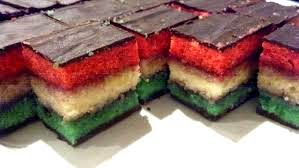
A Cookie Better Than Grandmother's

Photo by Cookingwithgrace.net

By Michelle Lulic

The thud of the glass jars hitting the counter suddenly overpower the soft crinkling of the plastic bags. My older sister and I quickly scamper into the kitchen to find just what we expected: the start of the holiday season. Pretty soon our home would be whirling with the aromas of butter, chocolate, peanut butter, ginger, almond, and raspberry. Each scent teasing our tastebuds with hints of what seven cookies we might place on Santa’s plate.

Every year a variety of different flavors make their way into our mixing bowl. The Scandinavian blood in our veins guides us through the recipes of seven different cookies. Just as it has guided my Norwegian ancestors after they skied home with all of their desired baking ingredients. Kitchens in my family tree have continuously given life to traditional favorites — such as the pepperkaker (the gingerbread cookie) and the kokosmackroner (coconut macaroons) — however, each kitchen has also opened its countertops to flavors we have not yet explored.

As my sister and I start sectioning off the ingredients, we aren’t surprised to see the jars of raspberry jam placed alongside the green and red food coloring and the golden bags of chocolate chips. My grandma’s rainbow cookie makes us salivate at just the mere thought.

The recipe, although accredited to my grandma, was taken from two German sisters she knew as a young girl. The three of them would play together and, one day, the two girls took my grandmother to their family’s German bakery. One bite of the baker’s rainbow cookie aroused my grandmother’s senses. She then begged the sisters to share the recipe. The girls entrusted my grandmother with the secret ingredients, thus weaving my Norwegian and Italian family with the German tradition.

For years my family has passed on the recipe from the two German sisters. But in 2011, the recipe surfaced where I least expected it. I was a freshman in college and was just about to spend my first Christmas with my current boyfriend of four years. He had insisted that his German mother made the best rainbow cookies in the world. We bickered back-and-forth as I insisted that there was no way it was better than my grandmother’s. We then placed each cookie into the center of each other’s palm. At the count of three I lifted his mom’s cookie to my lips and bit into the chocolate covering down through the moist nutty texture of its three layers. Both our eyes widened as the cookie swooshed around in our mouths. I can recognize that taste anywhere.

It remains a mystery whether our recipes came from the same German baker. Either way the cookie will always connect me to the love of my family and the love of my life. While the seven cookies chosen each year continue to cycle through, I can guarantee that one will stay on my list for generations to come: the rainbow cookie.

Michelle Lulic is a senior at Rutgers University, studying Journalism and Media Studies with a minor in Theater Arts. She loves to tell stories through both writing and acting.