New Jersey Food Journal

Saturday, July 4, 2015

NJ Oysters Climb to the Top

Photo Credits: Milford, NJ Oyster House

By Meenal Upadhyay

The New Jersey clam culture has been built on a long history, valuable aquaculture and much healthy competition. Today, Jersey clams are compared to the best of the best from Massachusetts and the West Coast. The shellfish itself is a popular menu item, as are chowders, dips and fried clam strips.

“Our long-range goal is to make New Jersey producers the shining star in the seafood industry,” says Neil Berger, the manager at Cold Spring Fish in Cape May.

“That’s what is really special about New Jersey seafood – the atmosphere and the memories that come with it.”
At Milford Oyster House, which was named by Zagat as New Jersey’s best seafood spot in 2015, the favorite item on the menu for years has been the Oyster House shellfish stew. Chef Edwin Coss says it’s not easy to reach the top spot. It’s all about providing something unique yet also comfortable and familiar, he says.

“Our ever-changing roster of oysters offers four to six selections each evening and we make sure each oyster is carefully hand scrubbed, delicately prepared, and served to ou
r guests with their choice of a cocktail sauce.”

To remain a top-rated oyster bar, says Coss, the restaurant also must serve a variety of seafood, to satisfy everyone.

At the Jersey Shore, clam chowder is popular; many restaurants call their versions “world famous” and “award-winning.” The Jersey clam chowder features tomatoes, bacon and potatoes. It was – and remains -- a staple at the Shore and is the kind of recipe that keepspeople coming back. It doesn’t just taste good, it reminds them of salty waters and ocean airs.

That’s what is really special about New Jersey seafood – the atmosphere and the memories that come with it.

Joseph Stallor, a Rutgers student, says he loves seafood, because it reminds him of “sunny weather, good vibes and happy times.”

Meenal Upadhyay is a senior at Rutgers University, studying Economics and Journalism. She hopes to some day become a financial analyst and when she's not busy, you can always find her eating some delicious food since every food is her favorite food!

Monday, June 15, 2015

Jersey Oyster Farm Keeps it Fresh

Photo credits: Forty North Oysters
By Serena Han

Sunsets and shoreline photos on Instagram are a dime a dozen. A close-up shot of a fresh oyster from New Jersey is not.

Forty North Oyster Farm’s Instagram feed is updated regularly with photos showing off the glistening sheen of wild oysters and their distinctly textured shells. Matt Gregg, founder of Forty North Oyster Farm, promotes his oyster farm the modern way, using social media platforms including Facebook, Twitter, Instagram, and the video hosting site Vimeo.
“It’s become my quest to grow the perfect oyster”

Gregg’s social media presence exudes a youthful vibe that most would not typically associate with oyster farming. Its online content reflects a millennial and current perspective on the fishing industry and this refreshing and unique angle separates Forty North from other oyster farming competitors.

Companies use social media for marketing, promotional, or customer service-related purposes, including Forth North Oyster Farm. However, Gregg’s social media efforts give off a contemporary and distinctly savvy feel. The image editing, quality, and overall aesthetics on its Instagram feed is impressive.

So much so, that Modern Farmer magazine recruited Gregg to take over its Instagram account for two weeks as a guest contributor. Gregg posted pictures of oysters, the farming process, and even photos of himself on the job, giving followers a first-hand look into Forty North Oyster Farm’s operations. Captions are educational and fun – how to fry mud crabs, for example, or tidbits about New Jersey marine culture.

Gregg cultivates the company’s image in ways that are appealing to other millennials. Forty North Oyster Farm’s merchandise has the same lightheartedness. A gray hooded sweatshirt, available for purchase on the company’s website, says, “I’m Not a Playa’ I Just Shuck A Lot,” a witty play on rapper Big Pun’s 1998 single “Still Not a Player.” According to Gregg’s caption on an Instagram post for Modern Farmer, the sweatshirt is a hot item for 26-35-year-olds who recognize the hip-hop song.

Photo Credits: ModFarm
Gregg is also featured in documentary-style trailer titled “Oyster Renaissance” that showcases him farming oysters. His voiceover plays dramatically over stunning footage of New Jersey oyster farming landscapes.  

“It’s become my quest to grow the perfect oyster,” says Gregg in the video clip. “I don’t think I’ll ever achieve that feat because, in this case, the definition of perfect is open to interpretation.”

The video, hosted on Vimeo and linked on Forty North’s website, is another dynamic way multimedia is incorporated to further curate the brand’s persona.

Gregg grew up in Monmouth County and graduated from University of Rhode Island in 2007. The marine and coastal policy major founded Forty North Oyster Farm out of a passion for aquaculture.

Today, Gregg continues to build Forty North Oyster Farm’s image and name through social media. According its latest Instagram update on May 5, Forty North farmers are harvesting oysters for spring 2016.

Oyster farming may be an unusual segment of social media but Gregg operates platforms like Instagram and Vimeo in ways that relate to younger audiences. The farmer possesses a keen sense of contemporary Internet culture and showcases Forty North Oyster Farm with that lens. Witty captions and high-resolution photos on Instagram are just a few of the components that keep Gregg’s business afloat.

Serena Han recently graduated from Rutgers University as a journalism & media studies major with a double minor in digital communication, information, and media and Korean. She hopes to work in entertainment media.

Monday, June 8, 2015

Oyster Farming: A New Start

Market-ready Oysters (Photo credits: Forty North Oyster Farm)
By Kimberly Dublin & Allyson Ricarte

He scooped the granola-like oyster seeds (baby oysters), cradling them with the hopes they’ll be ready in 2018. The seeds are about to begin a three-year journey in the tides of Barnegat Bay. But there is no bigger boss than nature, especially for oyster farmer Matt Gregg. “An entrepreneur never clocks out,” he said.

He may never be able to clock out, thanks to the swelling popularity of oysters and the resurgence of oysters at the Jersey Shore. For four years, Gregg has owned Forty North Oyster Farms. His business never runs on a routine but rather at the mercy of the ocean as his farm grows larger. In the spring, he eyes for crusty barnacle-covered oyster shells like the tips of grass popping for springtime.

“It all depends on natural variables,” Gregg said. “Right now I am making sure barnacles don’t cover oysters as we just had a set of new barnacle eggs. It’s a site specific endeavor that is rarely the same day to day.”

Gregg works on his boat when the tide is low, but even on shore, his hands are always tied. “It is difficult because I have to balance relationships with chefs that are used to working on a set schedule,” he said. “Other times I have to answer emails, build gear, go to meetings, take care of the paperwork side of things.”
But nature’s bad days are the busiest, crunching as much time as possible, he said. “When the weather is bad and we get behind in work we have to harvest, sort, maintain and deliver all in one day,” he said. “These are the sun-up to sun-down days and they’d be longer if possible.”

As his thumb-sized oysters bobbed in the murky ocean, Gregg also commits his time to preparing market-sized oysters for local chefs. “Two things (to indicate a good oyster): length and cup,” he said “If it has a nice deep cup and is over 2.5”, then it’s ready to go. We sell smaller oysters than most. It seems to be what the market is demanding.”

Gregg’s relationship with those chefs in Philadelphia, New York City, and New Jersey is just as important as his relationship with the environment. “I would like to set an example as someone who improves our environment while creating commerce,” he said. “It's always one or the other, but why can't it be both? Well, it can.”

To Gregg, the oyster provides an economic service. “Every cent I spend to grow an oyster goes into the local economy,” he said. But the oyster also provides its service environmentally.  “They create habitat and remove excess nutrients from our natural waterways,” he explained.

Gregg’s intense knowledge of oysters grew from working in an oyster farm in Rhode Island, a work that he loved. Educated in the University of Rhode Island, he earned a major in Marine and Coastal Policy with a minor in Aquaculture and Fisheries Science. He then decided to start something similar in New Jersey, after enduring the excruciating permitting process in New Jersey. “It takes way too long to access the permits, licenses, land to grow and sell oysters,” he said. But once he had access to those permits, Gregg has been going strong for the past four years.

The oyster industry’s decline in the New Jersey resulted from the destructive combination of “oyster disease, degradation of environment and over harvesting,” Gregg explained. In this case, much of the oyster population was decimated by “a protozoan parasite called MSX,” according to Wendy Plump in The Pearl of New Jersey for Rutgers Magazine. This caused New Jersey to no longer be called “the oyster capital of the world,” which various websites such as Cumberland County’s official homepage reported that the state used to be home to such a title. Gregg, along with many oyster farms in New Jersey, is slowly trying to gain back that title.

The revival of the oysters is important to the Jersey coast, their presence offering more than just environmental and economic services.  Oysters have been making a huge impact in the experience of eating. “When people come to the Jersey Shore, they want to eat food from here. It's a romantic notion that is nearly forgotten, but the chefs and restaurants we work with, they get it. So do their customers,” he explained.

 “Oysters are a social food, which is why they're so popular in metropolitan areas,” he observed. “Happy hour oysters in Brooklyn, Manhattan, Jersey City, Philadelphia are a huge social experience and a great opportunity to taste something so simple, but so delicious. Oysters, beer, friends.”


Kimberly Dublin is a senior journalism student at Rutgers University. She is a contributor to TheFatKidInside.com and is an editorial intern at EdibleFeast.com

Allyson Ricarte is a student at Rutgers University, studying journalism and media studies, art history, and digital communication. She hopes to work in Broadway production.

Monday, June 1, 2015

Catherine Lombardi's Pioneers

Jamon Iberico de Bellota (Photo credits: H.C.)
By Allyson Ricarte

As the glistening jamon iberico de bellota melted on the ordinary wooden cutting board, restaurateur Francis Schott resisted from dangling a thin slice into his mouth. Instead, he reeled through the oak forests of northern Spain and their tarrying pata negra pigs feasting on acorns. Catherine Lombardi’s is nothing without its stories.

“The difference between good and great is authenticity and also its complexity,” Schott said. “You’re going to taste this for a long time,” restaurateur Mark Pascal said.

Pascal shares the joys of Italian-American home cooked dinners of his grandmother, after whom the restaurant is named. The effervescent business partners bring to the dining table angelically soft mozzarella oozing after its fresh massage in salt water. They offer the flirtatious spark of orange garnish in their Brooklyn cocktail. Their ice balls seem magical. They’ve captured New Brunswick’s attention day and night.

However, chain restaurants are pushing independent owners out of the spectrum, Pascal said. “Because the thing about being an independent owner is that, (when) the Bennigan’s closed, the stock holders lose value on their stocks,” Schott said. “When some of these independent restaurants close, people’s lives are turned upside down.”

In addition, the decline in reflective food journalism doesn’t help, Schott said. Lists, such as the top 10 restaurants in New Brunswick, place emphasis on competition within restaurant services and demonstrate lazy journalism, Schott said. “I don’t view food as a contest,” Schott said.

Catherine Lombardi’s and co-owned restaurant Stage Left faced a similar conflict during the 2008 economic crisis that shook neighboring restaurants to discount overdrive. For Pascal and Schott, quality experience was without a doubt their best survival technique. “As far as plate went and service went, those weren’t compromises we weren’t willing to make,” Pascal said. “(Customers) didn’t have the money to do it (fine dining) for a while, but they didn’t forget that they enjoyed some of those finer things in life.”

Finer wasn’t the only term that resonated in their elegant dining room, but also simple. Call them pioneers, Pascal and Schott were determined to bring fresh ingredients to the table not because it was fundamentally a cool story, Pascal said. “We knew our guests well enough to say OK, do you trust me?” Schott said. “That was the key; we were the conduit between the producer that makes the cool thing and the people in the community so that’s how we view ourselves.”

Pascal and Schott also love to translate their food interests in their food talk show, The Restaurant Guys on 1450 WCTC. The program first aired in 2005 for nine years before its hiatus. They intend to return in the near future, Pascal said. These brotherly partners couldn’t wish any more from their jobs. “I chose this because I love all of the parts of this,” Pascal said. “I love the people parts of this. I love the food parts of this. I love the hospitality parts of this.”

Allyson Ricarte is a student at Rutgers University, studying journalism and media studies, art history, and digital communication. She hopes to work in Broadway production.

Saturday, May 30, 2015

Honest Investments for Garwood Bakery &Grain

Photo credits: Susanne Davidson
By Allyson Ricarte

His menu spoils customers with pain de mie French toast, polished with light syrup and snowy powdered sugar, and tender, piquant ham and brie baguette sandwiches worthy to be a guilty pleasure. If you’re lucky to visit &Grain, you’ll find no magic tricks behind the kitchen. Owner Jon Ropelski invests in the best quality of essential ingredients and pushes them to their full potential of flavor. His devotion to honest baking resonates in his passionate pursuits for intimacy and character, giving the bread its life, he said.

“If you have bread, you’ll never go hungry,” his French culinary professor said, but for Ropelski, bread fed more than his stomach.

 “I’m so invested in the business emotionally, financially, physically. It’s like this is an extension of me,” he said. He shared his challenges with the threatened state of small businesses, establishing &Grain’s character and the rewards of honest baking in a discussion with a Rutgers University food journalism class. Ropelski has charmed Garwood and its community since August 2012. Big and burly, he’s adamant in channeling his heart through his bread.

Ropelski wants a business with personality; he’s old-fashioned that way. “You go to the city (New York City) and all the buildings have character,” he said. “Their store fronts have a history like they want to tell you a story of how many people have walked in and out through that door.”

He also channels his integrity beyond artisan food. “It’s about taking pride in whatever you do,” he said. “That’s why I give people a lot of freedom here and creativity in the kitchen because I find that that’s missing nowadays.”

Ropelski, who majored in finance, originally planned to invest in a successful lunch business. “I thought good lunch is good sandwich is good bread,” he said with a white chef coat as pure as his breads. He looks up to traditional mom and pop type shops as an ideal model.

There’s a special personal touch shared in small businesses, but chain grocers threaten the growth of this intimacy, he said. “Yes the quality at Whole Foods is phenomenal, but you’re not the guy who’s at the fish market, down at the dock or in the seaport,” he said. “He picked that out with his own hands and knows the story about it.”

Ropelski relates to bread like a parent, challenging his perception of labor. Authentic bread-making taught him patience first and foremost, but it encouraged him particularly to respect deceivingly easy work, he said, his lucid blue eyes glistering. “Originally my father was telling me to buy a business,” he said. “I was concerned about buying a business because when the owner has a real personal touch, that’s the business in itself.”

Ropelski’s gut-driven investment from the start represents a drive for integrity that will stay with the community. “I would’ve made mediocre money, but I wanted something that was a bit more,” Ropelski said. “That’s not who I am. Everything I’ve ever tried to do in my life, I will try to be the best at.”

Allyson Ricarte is a student at Rutgers University, studying journalism and media studies, art history, and digital communication. She's an aspiring producer for performing arts.

Monday, May 25, 2015

The Bread of Life Lessons

Photo credits: Alexandra R. Meier


By Alexandra R. Meier

Breadmaking entrepreneur John Ropelski has learned his fair share of lessons over his two and a half years of owning his part-sandwich-shop-part-bakery, &Grain.

         Score the dough before baking a baguette. This keeps the shape of the loaf straight and neat.
         No matter what detractors think, pain de mie makes great French toast. Plus, this loaf is more versatile and less expensive than brioche.
         Watch out for your reflection. It may sneak up on you late at night and spook you, as the oven’s steam makes the bakery’s glass walls look like mirrors.

Located in Garwood, &Grain offers customers eight house-made breads, from five-grain to ciabatta, that are used to accent a variety of breakfast and lunch menu options, such as harvest turkey club and French toast. The eatery’s vibrancy is palpable; saturated in natural light, the space is filled with children eating kid-friendly PB&J sandwiches and mothers sipping cold-brewed coffee.
Historically, culturally and theologically speaking, bread is life, and Ropelski stocked up on a few life lessons during his journey that helped him craft today’s customer experience. Although Ropelski acknowledges that he can talk anyone’s ear off about bread, he keeps his set of life mottos short and sweet:

1.  If it sounds too good to be true, it usually is.
           
Perhaps biological engineering obliged Ropelski to become a breadsmith; he comes from a linage of Polish bakers. But Ropelski originally intended to pursue a career in finance and clinched an opportunity to work as a mortgage broker for Smith Barney (now Morgan Stanley Wealth Management) after college. The money seemed brisk and bountiful and was, foreseeably, too good to be true. “I didn’t look at the long term plan,” Ropelski admits. He saw the writing on the wall for the market’s inevitable demise, and backed out of the mortgage industry. Unlike his colleagues, who wasted their paychecks on fancy cars, Ropelski saved his money. He had always wanted to open a business, and at that moment, the door to the metaphorical oven had opened.

Photo credits: Alexandra R. Meier


2. Nothing in life is free.

By the time &Grain opened in August 2012, Ropelski certainly understood that nothing in life is free. Hurricane Irene pushed back the first year of construction, and her big sister Sandy disrupted the eatery’s opening. By the time &Grain was up and running, Ropelski had only $3,000 to his name.

It took Ropelski a bit longer to learn that perfecting a skill also comes at a price. With his background in finance, he assumed his entrepreneurial endeavor would be a cakewalk. He would research budgeting, find equipment, and take a two-day breadmaking class. He had no desire to actually bake the bread — Ropelski just wanted to ensure that a baker couldn’t potentially use the signature recipe as blackmail. “I thought, ‘How hard could [breadmaking] be?’ ” he remembers. “I guess because [bread’s] so readily available and relatively inexpensive, it’s a food that nobody gives a second thought to.”

For Ropelski, learning bread would be a three-year process. On his first day of classes at the French Culinary, now the International Culinary Center, he told the head chef his original plan. She laughed, and warned Ropelski that he had “another thing coming to him.” So instead, Ropelski entered the school’s bread program, then exercised his practical muscles by working in New York-based bakeries. “The only way you can make good bread,” he eventually learned, “is by making a lot of bad bread.”

3. You get what you pay for.
           
This was last adage to attach itself to Ropelski’s triad of mottos. All of the mundane, methodical, and muggy hours spent baking, both as an apprentice and owner, taught him to respect craftsmanship. Before Ropelski hired a baker of his own, he spent 20 hours a day, seven days a week preparing and serving his breads. He compares this process to running a marathon. “There’s eight different breads I make here daily, and I will tell everybody that I have eight children,” he says.

Financially speaking, Ropelski usually breaks even, but he sees the most success in the response from the community. He notices his fair share of returnees. He has 4.5 stars on Yelp. And when his daughter was born, his apartment was filled to the brim with gifts from customers. “Everything I’ve ever tried to do in my life, I’ve tried to be the best at it,” he asserts. “If I was going to be a garbage man, I would be the world’s best garbage man. It’s about taking pride in what you do. I’m making bread, I want to try to make the best bread, and I can.”

Alexandra R. Meier is a Rutgers University senior, majoring in journalism and media studies. She is the former editor-in-chief of the university’s student-run newspaper, The Daily Targum, and will be interning for WABC-TV this summer.

Thursday, May 21, 2015

The Ampersand: How A Bakery in Garwood Embraced The Symbol

Photograph provided by Rachel
By Kimberly Dublin

There is so much more to &Grain, an artisan bakery in Garwood, than just delicious bread – that’s made fresh daily – and cold brewed iced Stumptown coffee on tap. It might be the quirky bicycle that sits in the middle of the café, with baguettes in its basket, as if you are walking by the transportation of choice of a French girl on the way to a picnic. It might be the handwritten chalkboard menu.

Or it could be that wherever you turn, the ampersand follows you.
The ampersand is certainly part of &Grain’s identity. The coffee cups bear the symbol. The employee aprons have ampersands embroidered on them. There are various materializations of the ampersand, all in different typography but in the same Carolignian form. (That’s this & symbol.) And John Ropelski, the owner of &Grain, certainly has thought about using the ampersand as branding, placing it on the smallest of details. Even the stickers on the to-go packages bear the little symbol.

There has been a resurgence in the usage of the ampersand. We can most likely trace it to Twitter, since the symbol saves precious space. But &Grain is not the only business to embrace the ampersand. Brands that have been around for a while, such as H&M, AT&T, Dolce & Gabbana and H&R Block, have all used the ampersand. But, for Ropelski, the ampersand has become a huge part of the identity of &Grain.

He didn’t like the name at first; it was a suggestion from his designer. “I wanted it to be Grain & Co., but she told me, ‘everyone is ‘& Co.’, everybody’s ‘& son,’” Ropelski said.

But the designer insisted, saying that it allowed people, who maybe didn’t understand the name at first, to be in the know when they got it.
Another reason Ropelski embraced the ampersand is that it puts his restaurant at the top of an alphabetical list. When New Jersey Monthly listed its “57 Hot Spots to Wake To,” his shop was first. “People thought &Grain was No. 1 because of the way it’s listed.”

But using the ampersand isn’t always easy. Ropelski has problems with vendors because sometimes ampersands are not allowed in the system they use. Social media sites, such as Facebook and Instagram, don’t allow the use of symbols in handles and URLs. Ropelski uses the word “and” to replace the ampersand.

But Ropelski isn’t all bogged down about it. A few inconveniences exist, but otherwise he is happy with the way the name turned out. Embracing the ampersand may have ultimately paid off.

Kimberly Dublin is a senior journalism student at Rutgers University. She is a contributor to TheFatKidInside.com and is an editorial intern at EdibleFeast.com

Monday, May 18, 2015

The Three Courses of Restaurant Regret

Large Meal provided by Rob Smith


By Michelle Lulic

As I sit in my tiny college dorm room, my stomach is begging me to feed it a nutritious meal. However, this healthy eating struggle is not only relevant when I am limited to eating at dining halls or heating up Ramen noodles before class. This nutrition scarcity problem occurs all school year. But the worst had to be when family members and friends wanted to take me out to dinner over Spring Break. While this may sound like a good thing, each friend, parent, and grandparent filled up my schedule with the healthy eater’s worst nightmare: “Where do you want to go out for dinner?”

Obviously, I’m not completely against going out for dinner. In fact, I love it! I have dreamt about feeling the heat of a freshly served sizzling fajita platter on my face. But allowing family to take me out for both lunch and dinner for four days straight taught me a terrible truth. Eating out is not as satisfying as you might imagine. Although my meals were varied with everything from fast-food, to chain restaurants, to mom-and-pop places, eventually it all just seemed to feel like I was eating the same thing. My food started to lose its significance as I emptied kitchens across the Long Island, New York area. I had everything from burgers, to tacos, to Chinese, to Japanese, to German, to both “Italian” at Olive Garden to Italian at my town pizzeria, Gino’s. Eventually I found myself blindly staring at each menu with no idea as to what I felt like having. I lost my appetite. My stomach needed a break.

But, why was eating out at so many restaurants making me feel so unenthusiastic about food? Only two out of the eight restaurants I ate at I didn’t thoroughly enjoy. But at the end of each day my stomach continued to feel as if it was going to explode. So, I decided to look into why I felt this way a little more. That’s where I found out the horrible truths. “As few as 3 percent” of selected Top 400 U.S chain restaurants were, “within limits for sodium, fat and saturated fat,” according to a 2013 study from Helen W. Wu and Roland Sturm. “Food portions in America's restaurants have doubled or tripled over the last 20 years,” according to The National Heart, Lung, and Blood Institute as well. In fact, “order an appetizer instead of an entrée, share an entrée or eat half of a meal and bring the rest home,” is what the National Heart, Lung, and Blood Institute suggests to people who are eating out.

Suddenly, it all made sense. Of course I was losing my appetite! Their higher portion sizes were making me take in more food than I am supposed to eat in one sitting. Plus, in addition to my initial meals, eating out made me eat more dessert than I usually do. Out of the eight restaurants, I got dessert at five of them — even when the rest of my meal was sitting half eaten in a doggy bag next to me. Dessert: a course I could have very easily avoided if I had eaten at home. 

Eating at restaurants was not only making me lose my appetite, but it also ended up emptying my bank account. Since I was “on vacation” I didn’t really pay too much attention to the prices. Therefore, I often found myself regretfully handing over my credit card to pay my share at the end of each meal. According to Zagat’s 2015 Dining Trends Survey, the average price per person for dinner out is $39.40. And that price raises to $48.15 when talking about a meal in New York City! It’s no wonder the restaurant industry plans on gaining $709.2 billion in sales in 2015.

Now that Spring Break is over, the last thing I want to do is eat out at another restaurant. I am on a search for fresh fruits and vegetables that I can prepare in my own kitchen. However, my stomach is growling as I write.

Michelle Lulic is a senior at Rutgers University, studying Journalism and Media Studies with a minor in Theater Arts. She loves to tell stories through both writing and acting.

Sunday, April 26, 2015

Coffee Rehab

Credit: Coffee photo via Shutterstock


By Jenny Goldberg

Its 2 p.m. and my flight from San Francisco to Newark has just been canceled. “We can not fly anyone out until Monday night after the storm passes,” the flight attendant tells me. After I mentally roll my eyes at the airline employee, and take a meditative deep breath through my nose, I call my dad. In a more calm conversational tone, I tell my dad my dilemma: I have a midterm exam on Monday, and need to be home by tomorrow the latest.  Dad tells me to go purchase a standby ticket from another airline company.

Following my dad’s collected and wise advice, I find my way over to United Airlines and purchase the ticket as told. I see five different potential flights, ranging from 2 p.m. – 10 p.m. This leaves me with a merciless six hours in San Francisco International Airport.

The longing for a cup of iced or hot coffee to get me through the next few hours begins to crawl under my skin like a parasitic disease. However, I can’t appease my craving, for I have been coffee-less for the past week.

Being an avid coffee drinker since the age of 16, it is safe to say that coffee is a staple in my diet. My addiction was rendered through my mom, who has forever embraced the sunrise with the smell of dark French roast coffee. These mornings before high school were characterized by lazy conversations over the kitchen table, while we sipped the hot dark liquid from our rainbow assorted coffee cups.

Through out the years, I submitted myself to the seduction of the taste, which has consequently affected my ability to feel awake naturally. In high school health class I rubbed off the lessons in which teachers told us caffeine is an addictive drug. Although science can explain the reasons, I never thought it was something I would find myself dependent on.  But as I sat in the airport with nothing to do but await my impending flight, I realized the seriousness of my addiction. The front of my head ached like there was a man pounding my skull with iron fists. My eyelids felt as though they were window blinds being pulled shut. I needed coffee but I continued to resist my temptation.

That night around 10:35 p.m., I got on a red-eye flight back home. At this point, my internal body clock had completely malfunctioned and the back of my neck was ready to snap off and walk away from me.

Although this experience was awakening to the seriousness of my coffee addiction, coffee is something that I am not willing to give up. Admit me to an anonymous meeting, but the smell, taste and feeling of coffee in the presence of morning’s dew becomes irreplaceable. These moments of small conversations at the kitchen table signify the small treasures in life that if not celebrated, become just another monotonous day in the life. 

Jenny Goldberg is a sophomore at Rutgers University with a major in Journalism and Media and minor in Cinema studies.

Thursday, April 23, 2015

A Cookie Better Than Grandmother's

Photo by Cookingwithgrace.net

By Michelle Lulic

The thud of the glass jars hitting the counter suddenly overpower the soft crinkling of the plastic bags. My older sister and I quickly scamper into the kitchen to find just what we expected: the start of the holiday season. Pretty soon our home would be whirling with the aromas of butter, chocolate, peanut butter, ginger, almond, and raspberry. Each scent teasing our tastebuds with hints of what seven cookies we might place on Santa’s plate.

Every year a variety of different flavors make their way into our mixing bowl. The Scandinavian blood in our veins guides us through the recipes of seven different cookies. Just as it has guided my Norwegian ancestors after they skied home with all of their desired baking ingredients. Kitchens in my family tree have continuously given life to traditional favorites — such as the pepperkaker (the gingerbread cookie) and the kokosmackroner (coconut macaroons) — however, each kitchen has also opened its countertops to flavors we have not yet explored.

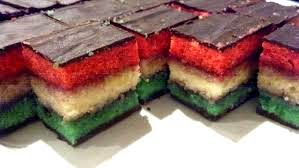
As my sister and I start sectioning off the ingredients, we aren’t surprised to see the jars of raspberry jam placed alongside the green and red food coloring and the golden bags of chocolate chips. My grandma’s rainbow cookie makes us salivate at just the mere thought.

The recipe, although accredited to my grandma, was taken from two German sisters she knew as a young girl. The three of them would play together and, one day, the two girls took my grandmother to their family’s German bakery. One bite of the baker’s rainbow cookie aroused my grandmother’s senses. She then begged the sisters to share the recipe. The girls entrusted my grandmother with the secret ingredients, thus weaving my Norwegian and Italian family with the German tradition.

For years my family has passed on the recipe from the two German sisters. But in 2011, the recipe surfaced where I least expected it. I was a freshman in college and was just about to spend my first Christmas with my current boyfriend of four years. He had insisted that his German mother made the best rainbow cookies in the world. We bickered back-and-forth as I insisted that there was no way it was better than my grandmother’s. We then placed each cookie into the center of each other’s palm. At the count of three I lifted his mom’s cookie to my lips and bit into the chocolate covering down through the moist nutty texture of its three layers. Both our eyes widened as the cookie swooshed around in our mouths. I can recognize that taste anywhere.

It remains a mystery whether our recipes came from the same German baker. Either way the cookie will always connect me to the love of my family and the love of my life. While the seven cookies chosen each year continue to cycle through, I can guarantee that one will stay on my list for generations to come: the rainbow cookie.

Michelle Lulic is a senior at Rutgers University, studying Journalism and Media Studies with a minor in Theater Arts. She loves to tell stories through both writing and acting.

Monday, April 20, 2015

A Thanksgiving Feast

Vending Machine illustrated by Jenny Goldberg
By Jenny Goldberg

We wait in line to sign in. The guard resembling a Neo-Nazi stares at us from over his desk. His bald head and menacing brown eyes make me feel small and insignificant. His crass voice breaks the silence. “Take out your license” he barks, and we obey. His pudgy white hand provides us with a piece of paper.  We fill out the sheet, my mother and my two sisters. This has become a standard ritual for us as we transform ourselves from people into simple broke -down demographics and data. My ease for laughter and lightheartedness disappear. With an OK from the guard, we leave the main entrance and go into the common area. The room is overwhelmingly hot, not only due to the number of people in the room, but to the excessive heat that blasts from the old and dusty vents. Dad says that this is the only room with proper heating in the entire facility.

My sisters and I collect chairs from throughout the room. We begin this conquest by asking people politely if we can borrow this and that chair. They nod, we thank them, no one smiles. I dread this most. I am intruding on personal time with loved ones. After we find a nice enough location to situate, I walk to the vending area, an alcove off the common area. A huge sign looms. “NO INMATES ALLOWED IN VENDING AREA.” Every time I read these words, every inch, blood vessel and bone in my body turns numb. I hate this place, and I hate how they treat my dad. Hate is a word not frequently used in my vocabulary. But on visiting days, hate is not just a word. It is part of me.

 I have packed enough quarters to weigh down my pockets. I approach the vending machine and slip quarters into the slot. Limited options are displayed behind the clouded finger smudged screen, but I don’t care. I want a colorful pretzel bag in the hands of my dad. I want him to know that things are going to be OK even if it is for only a few minutes. Pretzels are his favorite snack. At home during happier days, I would watch Dad grab handfuls of pretzels from our family fun-sized bag, and dip them, individually, into Heinz spicy yellow mustard. I reminisce on the countless pretzels Dad and I have shared at hockey games and state fairs. But reality stings me like a slap in the face as I realize we are not at the Meadowlands County Fair. We are someplace much different. A place surrounded by black hovering cameras, distasteful paint colors and gloomy strangers.

I needed to shine light on the past in order for my dad to remember a time when life was good. A time where laughter echoed throughout the cool summer air and happiness filled our lungs.

I enter D6 into the machine and watch the black spiral push the bag of Snyder’s pretzels from its designated place and fall gracefully into the bin below. I make my way over to my family and hand my dad the goods. With the pretzel bag in hand I watch his aged, downtrodden expression lighten, and for a split second I think I see the sides of his mouth curl upward. At this moment I know he is being teleported to happier places and times, and I watch him indulge his Thanksgiving feast.

The next two Thanksgivings are a blur. My family is physically back together, but mentally apart. We try to move on, but a gaping hole prevents us. I don’t know what to think of the past and I can’t shake the memories of visiting Dad in prison, so I hold on to them.

Jenny Goldberg is a sophomore at Rutgers University. She is a full time student, pursuing a major in journalism and media studies and minor in cinema studies.

Sunday, March 22, 2015

Home of the Heart in Heartbreak


By Emily Beckman

He said there was someone else – someone better. He said it was crazy and unexpected. Well, there was certainly no kidding about the unexpected part.

At that moment, my credit card felt the pain nearly as much as I did. The gym membership, the subscription to The New York Times, and the shopping sprees all led to this one moment -her.

A year ago, any impressive facts I could massage into conversation were gold for earning his attention. Reading The New York Times health section every morning to accumulate material to spark conversation became crucial in my daily routine. The love handles I had gained from reckless partying freshman year clashed against his six-pack, so I ran. I ran everyday with I Want Crazy by Hunter Hayes blasting on repeat for the last half-mile. My rebirth as a cardio bunny caused me to drop 15 pounds. More scientifically educated and more toned, I was on my self-created path to success.

But I was deceived. It all culminated to sitting at a table against the front window of the Country Pancake House. Cradling my mug of black coffee, I hypnotically watched the Ridgewood traffic whiz by. After awhile, I looked down again at my phone. Scrolling back through my Facebook newsfeed, the banner was still there. It featured a photo of him cuddling her on the beach, labeled as In A Relationship.

Tears welled up as I grabbed a square of cornbread from the woven basket aside a delicate dish of fresh butterballs. The sweet bursts of cocoa flavor from the embedded chocolate chips offset the taste of my coffee and my bitter emotions. The cornbread’s lofty yet rich body was reminiscent of a treat I’d expect to emerge from my grandmother’s oven – the treats that I had avoided for months to please him. I was hit with a sense of familiar comfort.  

I perused the menu, with more than 112 pancake options. Making a decision at the Country Pancake House is a chore, exactly what I needed to distract myself from the overwhelming thoughts circling my mind. So many options, most of which included chocolate or fruit compote. Looking around, I saw many families and couples happily indulging. What did I have to lose? Nothing. I already lost.

The downhome attitude that no one shall leave hungry rang true when I received my order of sugary apple cinnamon pancakes. With portion sizes that quadrupled the average breakfast eatery, it was obvious why the motto is “Home of the Hearty.”

Upon first bite, the fluffy, buttery body of the pancake slowly divulged the warm bits of baked apple, making way for the sweet, woody sensation of cinnamon. Not only did the food provide physical warmth, but it also saturated me with emotional warmth. For that moment, my ex was on the backburner and it was about me enjoying that stack of pancakes. With my epiphany, I relinquished my worries about counting calories or spilling food on my dress. Drowning my pancakes in syrup, I flagged my waitress for a glass of chocolate milk.      

Emily Beckman is a full-time junior student of journalism and media studies at Rutgers University. She is also the co-editor-in-chief and fashion director of TRIM Magazine, Rutgers' student run fashion and lifestyle publication (www.trimmagazine.net). You can contact Miss Beckman at ebeckman316@gmail.com. 

Sunday, March 15, 2015

Clarity in Cooking

Tuna salad photo by @kimdublin


By Kimberly Dublin

My relationship with food began in the Philippines 23 years ago. I was born a month early. I weighed 4 pounds. My relatives made it their mission to feed me.

Growing up, McDonalds and other fast food were a treat for me. Filipinos regard food such as pizza and burgers as meryenda, a snack. If you don’t eat it with rice, it’s not a real meal.

But after I moved to America when I was 9, it became a different story.

Microwaveable snacks began to crowd our freezer. TV dinners opened a whole new world. And because of the ease and the sheer volume of such convenient foods, I gained a lot of weight.

My relatives then made it their mission to put me on a diet. I was 11 when the nagging and the shaming started. It wasn’t that I didn’t know I was big, I was very aware. I eventually came to accept it. I had spent much of my pubescent years owning the fact that I was bigger than average. Before anyone else could make fun of me, I made fun of myself. When people inquired about my favorite hobby, I readily answered that I loved food, just to drive home the point.

At 18, I became vegetarian. But much of my diet still consisted of microwaveable foods – now only involving items that didn’t contain meat. After seven months, the Thanksgiving turkey won me over and persuaded me back to my meat-eating ways.

In my first year of college, I left the microwave for take-out. Delivery made everything easier. All I had to do was open my laptop and wait without ever leaving my bed.

It wasn’t until I moved back home during one of the most stressful semesters in my life that I had decided to pick up cooking. I had been watching the Food Network for years, always thinking, why not?

To this day, I’m unclear what lead to my moment of clarity. One thing is for certain: I decided to try my hand at cooking and have never regretted that decision. Some things came easy, such as putting various flavors together that complement each other. Other things, such as boiling water, took longer to master. Cooking was always daunting, but it has lead me to a better place, both physically and mentally.

Cooking also has become meditative. It constantly reminds me to be in the present. It has helped clear my mind, and I am happier. You can really find zen in chopping vegetables.

The more I learn about food, the more I care about not just its origins but the processes in which to prepare them. I’ve begun to make dishes with fresh ingredients and am learning more about nutrition.

I still have a complicated relationship with food. Sometimes my body craves chicken nuggets from McDonalds, and I’m OK with that. I’ve come full circle -- fast food and other junk are for once in a blue moon. Though I don’t call them treats anymore. I think the food that I make is much more special.

Kimberly Dublin is a senior journalism student at Rutgers University. She is a contributor to TheFatKidInside.com and is an editorial intern at EdibleFeast.com

Friday, March 13, 2015

Destination: Pesto

Self-made pesto in mortar by Flusel


By Mary Kubik

Growing up in Lambertville, I knew warmer weather was approaching when I heard my dad calling me from down the hallway to go for a bike ride along the Delaware Canal towpath. I would barely make it out of the gate before he bellowed “helmet!” in a deep, baritone voice. Once the helmet was on, any attempts at appearing cool vanished, as none of the other neighborhood kids were forced to wear one. But dad’s advice was that it was better to be alive and dorky than cool and dead.   

Our average ride was 2 miles and our destinations consisted of two places. One was a boat dock and access to it required a ride down a hill that jerked your body around more than a roller-coaster. Our other, no doubt preferred, destination was what the townies refer to as the “wing dam.” It is a concrete structure about 15 feet wide and 150 feet long that extends into the river. In either location, an immediate rock-skipping contest took place. Once the victor had reached eight skips, we would sit and talk while watching the sunset. Popular topics for conversation included soccer, which was our favorite sport, and what I wanted to be when I grew up, which changed constantly.

Returning home from a ride, dad’s move was to fill a glass with ice and grapefruit juice, often returning to the fridge for another refill. I stuck with the classic, boring choice of plain water. After we had quenched our thirst and replaced the liquid our bodies had sweated out, it was time for making pesto. Every ride would end with pesto. This was my favorite part.

With two older brothers whose interest in bike rides and cooking was minimal, I was the one chosen to be the chef’s assistant, which gave me a sense of purpose and satisfaction. My job was to peel the basil leaves and most importantly, to be the taste tester. Together my dad and I would take a piece from a fresh baguette he had purchased earlier that day and dip it into the blender filled with the creamy, pungent, savory pesto mixture. As we slowly chewed on our bits of bread, letting our taste buds absorb the various tastes, we would contemplate what ingredient needed to be increased. What would take it from merely good to brilliant? Was it more pine nuts, garlic, olive oil or basil leaves? Sometimes it would be olive oil -- olive oil he insisted must come from Italy. Usually we wanted more garlic. Garlic is the golden ingredient. Everything could use more garlic. Any guests who tried dad’s pesto were first asked if they liked garlic. The garlic sticks with you until the next day, the smell emanates from your fingertips. To me, that is what made the dish.

After trying 20 or some odd pestos from various restaurants and countries, my dad’s pesto comes out on top. I rarely find that there is enough garlic added to the mix, an ingredient that in my opinion complements the earthy and subdued flavors of the pine nuts, and the smooth, lush flavor of good olive oil. Most pestos are bland, tasting like grass and grainy chunks of dirt, generally lacking the punching flavor I recall so well.                     

January of this year my dad got a job at University College London as the chair of the Eastern European Studies Department and will be there indefinitely. While we Skype often, and discuss my future visits to London, the absence of his presence in my daily life has left an emptiness. I long to hear the bellowing cry of “helmet!” that used to embarrass me when I was a teenager. Since his departure, I went on a pesto search. In all pesto-tasting situations, I stared at the plate, announced to myself, “You will be the next best pesto, my friend?” Perhaps I hoped to find a pesto that would immediately transport me back to those bike-riding days.

After many failed pesto tastings, I accept that I will have to wait for him to visit until I can finally savor the sauce I love and desire. Making it together, side-by-side, dipping piece after of baguette into the mixture until it was just right, that is what made the pesto. I vow to one day share the art of pesto-making with my children the way my dad did with me, giving them their own feelings and flavors of specialness. No restaurant can serve that on plate.  


Mary Kubik is a senior at Rutgers University, majoring in Journalism and Media studies with a minor in History.

Tuesday, February 24, 2015

An Uncelebrated Gift


By Jessica Britvich

I stared at the bag of potato sticks in my hands as I crossed the yard from my neighbor’s house to my own. My face stared back at me, a distorted reflection on the blue aluminum bag that announced “POTATO STIX” in a bubbly font too whimsical and excited for a day like today.  “I can’t eat these,” I thought to myself. These aren’t supposed to be mine.I imagine my neighbor navigating the aisles of our local grocery store just the day before. Despite bad knees and arthritis, she managed to fill her buggy with the essentials for a homey and humble belated Christmas dinner. Sweet potatoes, a rotisserie chicken, a box of chocolates for dessert. Maybe that’s when then the shiny blue wrapping and red bubble letters caught her eye.

As she reached for the bag, maybe she reminisced on the days when her son would run home from school, kicking his shoes off right at the door and sliding on the linoleum floor to the kitchen pantry where he would reach for his favorite snack. As she placed the familiar bag of potato sticks in her cart, maybe she smiled, thinking about the days when her biggest worry was snacks before dinner. Before her son had a child of his own, before her son had cancer.

“But I know that when she pulled the blue-and-red bag of potato sticks from her pile of groceries and placed it on dining room table, she wasn’t thinking of me.”

As she walked to the checkout line, maybe she thought about her granddaughter. Maybe she pictured her coming through the door and smiling at the bag of potato sticks waiting for her on the dining room table. Maybe the red-and-blue bag was a snack exclusive to grandma’s house, only to be eaten on grandma’s lap as the family sat around laughing and smiling and simply being.

My neighbor may have thought of all of these things. But I know that when she pulled the blue-and-red bag of potato sticks from her pile of groceries and placed it on dining room table, she wasn’t thinking of me.

But then a family visit turned into a totaled car, a visit from the coroner and later, a visit from me. We sat and cried over the story of how her son was supposed to die of cancer but didn’t. And how her granddaughter was supposed to grow stronger from the experience, except she never had the chance. As I was about to leave, she led me to her dining room where she picked up the centerpiece, a blue-and-red bag of potato sticks. “You and your sister are my girls,” she whispered.
I entered my back door and placed the bag of potato sticks on the counter. I didn’t feel that they were mine to eat.  Because these potato sticks are not supposed to be mine. Because her family is not supposed to be dead.

Jessica Britvich is a senior at Rutgers, double majoring in Journalism and Political Science. 

Thursday, May 8, 2014

#DearFatSandwich

Photo illustration by Amber Figueroa
By Jordan Pringle 

Visit us on Facebook or Twitter to join the conversation.

#dearfatsandwich I don't know what I would have done without you those mornings when I had a 9:50am class at Scott Hall. You kept me awake. – Rebecca Welsh

#dearfatsandwich The grease trucks were hands down the best place to people watch  lol. – Ericka Ramsay

#dearfatsandwich There's a picture of me on the grease trucks haha. – Jennifer V.

#dearfatsandwich I never had one but I heard great things! – Sabree Waleed

#dearfatsandwich every time i go to the Rutgers New Brunswick campus, I look forward to ordering from you! see ya next time! – Judah Pringle

#dearfatsandwich I'm sooo happy you guys didn't leave permanently... I heard rumors you guys moved but didn't know where. – Aundrea Marie

#dearfatsandwich Aww man! I can taste a mojo! Aww man! Sounds like a grease truck run is in order.  – Arthur Brown

#dearfatsandwich  I could really go for a veggie koko right now, I know it's a lame sandwich as far as grease trucks go bu it's oh so good!! – John Claffey

#dearfatsandwich It's all about mozzarella sticks and French fries with marinara – Megan Baylies

#dearfatsandwich Graduated in 1994, need to go back and have a Fat Darrell! – Jimmy Page

#dearfatsandwich Fat bitch was a good sandwich – Chris Alosi

#dearfatsandwich  Fat Knight was the bomb! – Mike Drale

#dearfatsandwich  Taylor ham + scrambled eggs + cheese = a little slice of heaven – Mike Karafa

#dearfatsandwich personally R think they should go Chain!...Grease Trucks Everywhere!!!!! – Timothy Juda

#dearfatsandwich I wanna FAT CAT OR A FAT MOON!!!!!!!!! Damn I miss them Grease Trucks!! – Kelly Aberly

#dearfatsandwich sorry we never really got acquainted – Asana Akpaeti

Jordan Pringle is a senior at Rutgers majoring in journalism and media studies with a minor in psychology.

Wednesday, May 7, 2014

The Fat Darrell, Reimagined

Photo illustration by Amber Figueroa

New Jersey Food Journal asked the culinary experts at the legendary Ryland Inn in Whitehouse Station to reinvent the Fat Darrell.

By Nicholas Andre

In reimagining the Fat Darrell, Martyna Krowicka elevates tomato, chicken and cheese to create a more healthful, yet still satisfying, sandwich.

Krowicka, sous chef at The Ryland Inn, swapped out standard Italian bread for a tomato-studded version that is similar to focaccia. Instead of mozzarella sticks, she used breaded Tallegio, a mild, semi-soft cheese. The French fries have been replaced with crispy, mandolin-cut, fried potatoes, and soggy chicken fingers are exchanged for chicken thighs poached in maple sap, rosemary and thyme. The thighs are dredged in flour, smoked salt and paprika, then fried to a deep golden brown.

Standing in for standard marinara is a smoked tomato reduction, which may be the best ingredient of the entire sandwich. Made with garlic, shallots, brown sugar and olive oil, Krowicka confessed it’s a favorite of the Ryland’s kitchen staff.

The taste difference is extreme. The simplest way to describe it? You feel good after eating Krowicka's sandwich, as if you've eaten something with substance. After eating a Fat Darrell, you feel lethargic and tired, almost nauseous for having eaten the whole thing. The Fat Darrell, coming from a Grease Truck, is messy, and tastes like you're just eating a giant French fry in a lot of ways. In the reimagined sandwich, you taste each ingredient. The fresh chicken, crunch from the potatoes and the sweetness of the sauce all work together.

Don't expect to see Krowicka's sandwich on any menus near campus anytime soon. It's not supposed to be something that everyone can rush out to order. Instead, or at least I'd like to think, it goes to show that the food you love can offer more taste, and fewer calories, with a little thought and fresh ingredients.

Nicholas Andre is a senior at Rutgers University, majoring in journalism and media studies, currently working for 90.3 The Core, the only student-run radio station at Rutgers.

Tuesday, May 6, 2014

Fat Sandwiches: What People Are Saying


Interviews conducted by Johanna Aroca and Stephanie Greene.

Johanna Aroca is a senior at Rutgers majoring in journalism and media studies.

Stephanie Greene is a senior student of journalism at Rutgers University. She is also a blogger, freelance editor and writer with prior experience in media production. Ms. Greene can be reached at steph.greene92@gmail.com.

Monday, May 5, 2014

For High School Senior, a Greasy Welcome

"Fat Darrell" creator Darrell W. Butler outside RU Hungry, one of the Grease Trucks at Rutgers University.

By Erica M. Szkola

In front of Scott Hall on the College Avenue was the last place I thought I’d be. My friend and I were hungry that summer night. If it were any other day, it would have been a quick run to the nearest fast food place and back to my movie marathon. On this day, we decided to be more adventurous.

As we crossed the street into the parking lot, the smell of grease overpowered us. Music blared from the four trucks in the lot. A crowd of Rutgers students yelled orders in what seemed to be a very unorganized fashion. Yet the man popping his head out of the truck didn’t miss a single order. He seemed to rather enjoy it, as did the students. But what exactly was inside the brown paper bags?

“We’ll have two fat beaches,” said my friend Jessie. “Erica, you can’t come to Rutgers next year without having a Fat Sandwich, it’s a tradition.”

“I ate until I couldn’t eat anymore. I looked down at my lap. Still half a sandwich left. I just couldn’t do it, and I felt defeated.”
The Fat Sandwiches had the most interesting combinations of ingredients. At first glance, they didn’t seem appetizing at all. How was it possible to fit so many side orders into one paper bag? It still boggles my mind.

But there it was, heavy in my hands: cheese steak, chicken fingers, mozzarella sticks and French fries, completed with a mixture of ketchup and mayonnaise inbetween the warm, slightly toasted roll. I wasn’t sure how to go about taking a huge bite of the sandwich, so I began eating the fries individually. I understood by the blank look on my friend’s face that that was definitely not the way you were supposed to eat it.

When I had the first bite, I understood why a Fat Sandwich was such a big deal at Rutgers. A sensation of satisfaction. An entire meal in one sandwich, yet none of the flavors overpowered. An impressively fulfilling meal, as unhealthy as it was.

I ate until I couldn’t eat anymore. I looked down at my lap. Still half a sandwich left. I just couldn’t do it, and I felt defeated. It was the first time visiting the school I would be attending in a couple of months and I couldn’t even finish a whole sandwich. “It’s OK,” Jessie reassured me. “I don’t know many people who could finish an entire Fat Sandwich on their first try.”

Something about the smell of grease, and the way students gathered in all hours of the misty night to share the experience of the Fat Sandwich, made it feel like college. It was a first welcome to Rutgers. At that moment, I wasn’t a soon-to-be high-school graduate, I was a Scarlet Knight.

Erica M. Szkola is a junior at Rutgers, majoring in journalism and media Studies with a minor in cinema studies. After graduation, she plans to pursue a career in film/TV production and writing.  

Sunday, May 4, 2014

Fat Sandwiches: What People are Saying


Interviews conducted by Johanna Aroca and Stephanie Greene.

Johanna Aroca is a senior at Rutgers majoring in journalism and media studies.

Stephanie Greene is a senior student of journalism at Rutgers University. She is also a blogger, freelance editor and writer with prior experience in media production. Ms. Greene can be reached at steph.greene92@gmail.com.